Why a Door Handle Can Feel Right Before You Notice Why
A door handle can feel right when its grip, scale and placement suit the hand and the door’s movement, making everyday use feel clear and easy.
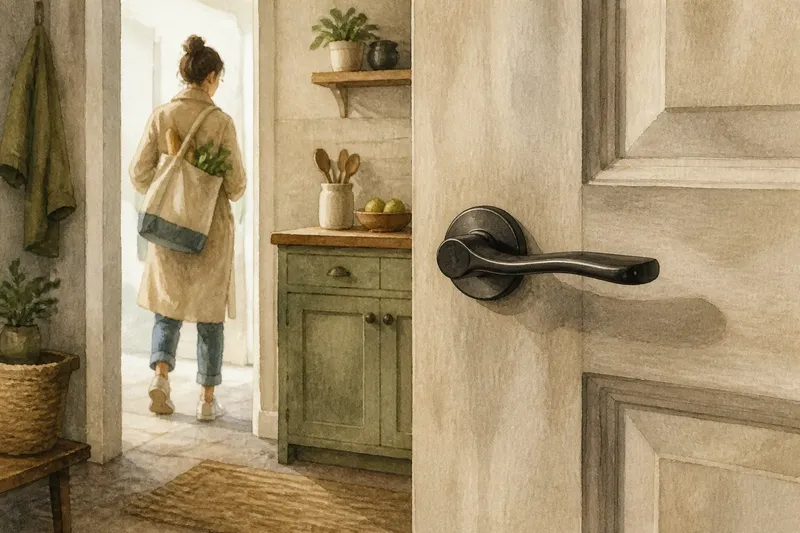
The common mistake with a door handle is judging it by appearance alone. A beautiful knob can cost you a moment of fumbling when your hands are full; a plainly shaped lever may tell your hand what to do before you have even looked at it. The difference comes from a set of small decisions working together: grip, scale, shape and placement.
What the hand reads
A handle is one of the few objects we often use without looking. Your palm, fingers and wrist take in its shape, then respond. A rounded knob invites a turning grip. A lever offers a place to press down. Those cues are simple, but they matter most when you are carrying a mug, guiding a child or entering a dark room.
The familiar round knob gives the hand a clear centre to wrap around. Its smooth outline can suit a door that is opened with a deliberate grasp, though wet or stiff fingers may find a small, slippery knob less accommodating. A lever spreads the task across the hand: fingers can press, or an elbow can push it when the hands are occupied. Neither form is universally better. The useful question is what the door asks of the person using it.
Texture also changes the message. A finely ridged edge gives the fingertips something to register. A broad, polished surface feels calm and unobtrusive, but may offer less purchase. On a frequently used kitchen door, a finish that shows every fingerprint can become a daily irritation even if the handle feels excellent in the hand.
Try noticing the first point of contact, not just the overall silhouette.
Scale and reach
Scale is relational. A short lever on a tall, heavy-looking door can feel pinched, while an oversized handle on a small cupboard door can seem awkwardly dominant. The hand should have room to settle without the handle overwhelming the door around it.
Think about the distance between the handle and the door surface, too. A generous gap can make a lever easier to curl fingers beneath; a tight gap may leave knuckles brushing the panel. A round knob projects differently, so the hand approaches it from several directions. These details become clearer when you use the door rather than inspect the fitting from across the room.
Imagine you are choosing a handle for a pantry door beside a narrow passage. The existing knob catches a shopping bag as you pass. A lever with a compact profile might give the bag less to snag on, while its projecting end still offers a clear press. The useful observation is not that levers always suit narrow spaces, but that the handle’s reach into the path changes how the doorway behaves.
Look at the handle against the door’s thickness, nearby walls and the route people actually take.
Shape suggests movement
A handle feels intuitive when its form hints at the action that will open the door. A lever’s horizontal line suggests downward pressure. A D-shaped pull suggests drawing the door towards you. A flush finger pull signals that the hand should hook into a recess rather than grasp an object projecting from the surface.
The direction of that cue matters. A pull fixed on the side that moves towards you gives the hand something to draw. On a door that swings away, a push plate or bar may make the action easier to read. If the hardware says “pull” while the door needs a push, people hesitate or try the wrong action. The mismatch can be subtle, but it interrupts an otherwise simple movement.
Look at the entire fitting, not only the part your hand touches. A backplate can frame a lever and make its direction more visible. A small escutcheon around a knob can give it a visual anchor. On a sliding door, a recessed pull keeps the face relatively clear and avoids asking the user to reach around a projecting handle.
Shape works best when it agrees with the door’s motion.
Placement in the doorway
Even a comfortable handle can feel wrong when it sits where the hand does not expect it. People build a quiet sense of where a handle belongs from repeated use. Keep it consistent across a run of similar doors, and the hand can move towards it with little thought. A sudden change in height or side may prompt a search, especially in a dim corridor.
Placement also affects the turn of the body. A handle near the hinge asks the user to reach closer to the pivot, while one farther away gives more leverage on the door. The difference is noticeable on a reluctant door, but the surrounding wall, trim and door construction can limit where hardware can go. The best position is a practical fit for the door and its users, not an abstract rule.
Consider who approaches the door and from which side. A cupboard handle may need to be found by a seated person, or a room door may be used by someone carrying a tray. A handle hidden behind a nearby open door can be hard to reach even if it looks neatly centred on the panel. Observe the approach path and the door’s resting position.
Check the handle from the place where you first reach for it.
Why does a handle feel intuitive?
Why does a lever feel easier than a knob?
A lever can be pressed with fingers, a palm or an elbow, while a knob usually asks for a wrapping grip and a turn. That can make a lever feel more direct when hands are occupied, though comfort still depends on its shape, projection and the person using it.
Does a larger handle always feel better?
No. More surface can give the hand room, but a handle that projects too far may catch clothing or bags and can look out of scale on a small door. Judge its usable grip alongside the space around the door.
Why do some handles feel slippery?
A smooth finish, a rounded profile or a small gripping area can leave the fingers with little purchase. A textured edge or a shape that the hand can settle around may feel more secure, while the surface still needs to suit the room and the way it is cleaned.
Where should a door handle sit?
It should be comfortable for the people who use the door and clear of nearby walls, trim and furniture. The door’s construction and hardware instructions can constrain placement, so check the manufacturer’s guidance and any local requirements before changing fittings.
Small cues, daily use
A handle rarely needs to announce itself. Its success may be the absence of a pause: the hand finds it, understands the grip and completes the movement. That is why comparing a fitting in a showroom can be misleading. A handle mounted on a sample board does not reveal how it feels beside a tight wall, on a cupboard used with one hand, or on a door that opens into a busy room.
If you can, try the same shape in the actual setting before choosing. Notice whether your fingers meet an edge, whether your wrist has to twist sharply, and whether the door opens in the direction your body expects. These observations help more than choosing by finish alone. Brass, timber, ceramic and stainless steel each bring a different surface feel, but material cannot rescue a grip that does not suit the movement.
For a door handle that feels right, start with the action: grasp, press, pull or slide. Then consider the hand’s reach, the fitting’s projection and the space the door occupies. The most convincing choice is often the one whose form makes the next movement obvious without asking for attention.