The Parlour Before the Living Room
The parlour before the living room shows how domestic space shifted from formal reception to shared leisure, changing furniture, habits and ideas of home.
The common mistake is to treat the parlour as an old-fashioned living room with a different name. In Britain, the change from parlour to living room took shape unevenly across the nineteenth and twentieth centuries, alongside changing domestic routines and room names. That context matters: there was no single moment when one room type simply replaced the other.
Rooms with social duties
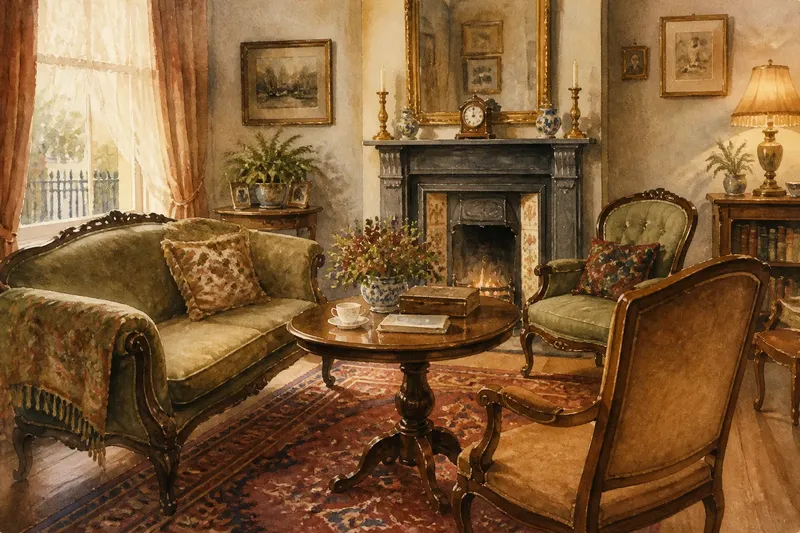
A parlour was often the most carefully presented room in a house. Its name suggested conversation, but conversation there had a particular setting: guests were received, family news exchanged and social relationships maintained. The room made hospitality visible. It also showed that a household could set aside space, furnishings and attention for occasions beyond everyday work.
This did not mean every parlour was grand, or that every household had one. Homes varied with income, size and local custom. In a modest house, a front room might serve several purposes; in a larger one, the parlour could be distinct from the kitchen, work areas and sleeping rooms. What matters is the room’s social role, not a fixed floor plan.
Visitors were often received in a space near the entrance, where they could be welcomed without being led through the whole home. The arrangement drew a boundary between public-facing hospitality and private domestic life. A parlour was not public in the civic sense, but it was the home’s stage for people who did not belong to the household.
Furniture for receiving
Furniture helped establish that role. Chairs arranged to face one another encouraged conversation, while a sofa or settee gave the room a composed centre. A small table might hold tea, correspondence or decorative objects. Curtains, a rug, framed pictures and a mantel could make the room feel finished, even when other parts of the house remained plain or busy.
The arrangement was not simply about comfort. It made visitors legible to one another and gave hosts a way to direct a gathering. Seats placed around the room supported polite conversation; a clear route from the door to the chairs kept arrival orderly. The room’s objects quietly instructed people how to behave.
Care was part of the design. Better textiles and polished surfaces could be kept away from cooking, muddy boots or children’s play. A parlour might be used less often than a kitchen or workroom, yet receive more attention before guests arrived. Its appearance represented the household, so tidying it was a social task as much as a domestic one.
Leisure moves indoors
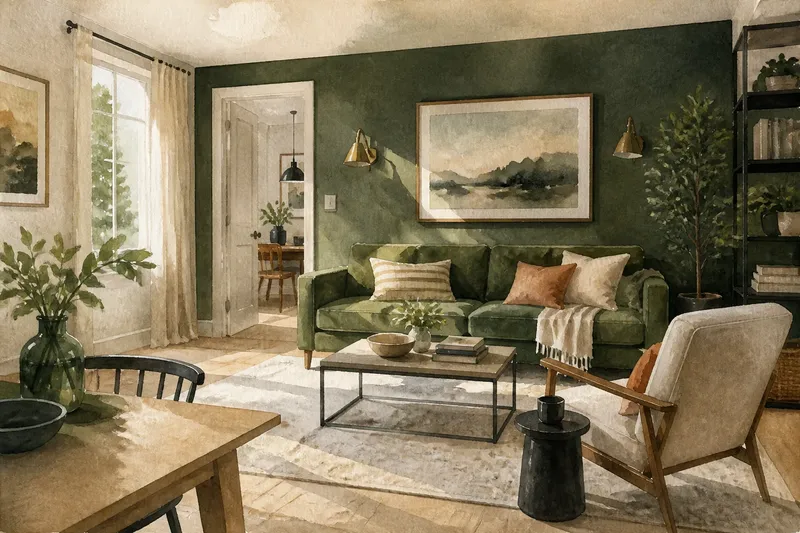
In Britain, the move towards a living room was gradual, not a clean break or a single invention. During the nineteenth and twentieth centuries, domestic ideals and routines shifted, and shared leisure—reading, conversation and listening to music—became part of how some households used their interiors. Later forms of entertainment added further reasons to gather. The timing and arrangement differed by household, so this account describes a broad pattern rather than a universal sequence.
That changing use altered what counted as a successful arrangement. A chair could be turned towards a bookcase or a shared activity, rather than towards the door. A table might carry games or reading matter, not only refreshments for guests. Furniture needed to support repeated use, and not just present a respectable scene.
The distinction was never absolute. Families still welcomed visitors, and formal reception did not vanish. But a room used by its occupants every day could not remain only a display. Comfort, access and flexibility gained importance alongside appearance. The living room came to be associated with what people did there, rather than a single social occasion.
Privacy and family life
As leisure became a more visible part of domestic life, the interior also expressed a changing idea of family. A room for shared recreation suggested that household members could spend time together without hosting anyone. It gave ordinary companionship a place and made family life itself a design concern.
This was not automatically a more equal or relaxed arrangement. Household labour still shaped who could sit down, when a room was available and who was expected to keep it presentable. In some homes, a room’s comfort depended on unseen work elsewhere. The change in room type therefore tells us about ideals and habits, not just about furniture.
Nor did greater informality mean the end of boundaries. The living room could still be kept separate from bedrooms and work areas. Instead, it often occupied a middle position: more private than a reception room arranged for callers, but shared rather than secluded. That combination made it useful for both family time and social visits.
Reading the room today
Looking at a parlour or early living room, notice what the layout asks someone to do. Is seating aimed towards a doorway, towards one another, or towards a focal object? Are surfaces protected and sparsely used, or ready for books, cups and games? Do furnishings leave a clear path for visitors, or make room for people to settle in?
These clues are more useful than deciding that one room is formal and another comfortable. A reception room may invite lively conversation, while a living room may still be carefully arranged for guests. The difference lies in the habits the arrangement supports and the people it places at the centre.
Say you inherit a small front room with a sofa facing the entrance and a side table holding only ornaments. For this invented situation, suppose your aim is to use it for family evenings as well as callers. You turn the sofa towards the other seats, move a reading lamp within reach and clear one surface for a shared activity. The expected visible result is seating that supports conversation between occupants, with a usable spot for reading or a game; the trade-off is that the original formal view from the doorway changes. The point is not to make a historical room look modern. It is to see how furniture can signal who the room is for.
What changed and stayed?
Was the parlour only for guests?
No. Household use varied, and a parlour could serve more than one purpose. Its defining tendency was to be arranged and maintained for reception, even when family members also used it.
Did the living room replace the parlour?
Not in one universal step. Names and room arrangements changed unevenly, and some homes kept a formal front room alongside a more everyday shared space.
Why did furniture arrangements matter?
Seating, tables and clear routes shaped how people gathered and what they could do comfortably. A room’s arrangement could favour orderly reception, relaxed conversation or a mixture of both.
What is the clearest difference?
The parlour placed special emphasis on receiving people from outside the household. The living room placed more emphasis on shared leisure among its occupants, while remaining available for visitors.
Domestic purpose in view
The parlour before the living room is not simply a story of stiff furniture giving way to softer sofas. It is a shift in domestic purpose: from a room that made hospitality visible to one expected to sustain everyday leisure. The furnishings reveal that shift, but so do the routes through the house, the work required to keep a room ready and the routines that made it feel occupied.
When you encounter a formal front room, ask who was expected to use it and on what terms. That question turns a familiar interior into evidence of how a household balanced display, privacy and shared time—and why the living room came to feel like the centre of home life.